0.4.0, open source · for the ZECTRIX NOTE4C Devkit
A calm poster of your day.

emini Home puts the forecast, one headline and a few words of your own on a small four-colour e-paper display. You set it up from your phone. After that the device fetches, draws and schedules everything on its own, without an account or an emini server in between.
The display
One forecast, three compositions.
In the panel, pick a composition for each screen, or choose In turn and let all three take turns.


- Rhythm Draws the coming hours as a curve, so you can see when it warms up and when rain arrives.
- Atlas Gives the sky half the page and leaves the numbers the other half.
- Print Reads like the corner of a newspaper: the big number first, the sky beside it.
Under the temperature, each composition shows the range for the next 24 hours, then one short line about rain, such as “Dry until 21:00” or “Rain from 18:00”.
With In turn, a screen shows Print, then Rhythm, then Atlas, moving on each time it comes back to the display. A screen that stays on the display moves on after the minutes you set in Change composition every … minutes, 30 unless you change it, but not during quiet hours.


One headline. From BBC World, or from a public RSS or Atom feed of your choice, as long as it is served over HTTPS. A link to the full story waits in the panel.

Your note. A reminder, a line from a friend, anything worth keeping in view.
There is no grey on this display.
Every pixel is black, white, red or yellow. To draw warmth, light and cloud, the renderer mixes the four pigments in ordered patterns, the way a printer builds a shade out of dots. Red and yellow patterns are never finer than 2 pixels, while black and paper can still use single pixels. The picture stays on the display even without power.

Pick the grain and the colour
In Settings → Appearance you set how coarse the pattern is and how much colour it uses, for every screen at once. Because colour never goes below 2 pixels, Fine and Medium differ only in their black patterns. Here is the same sky with each choice.
Pixel texture
 Fine 1 px, colour 2 px · default
 Medium 2 px
 Large 4 px
Colour use
 Black & white no colour
 Balanced less colour
 Expressive full colour · default

The phone panel
Your phone is the remote.
The NOTE4C serves its own settings page over Wi-Fi. There is nothing to install on the phone, and your settings stay on the device.
-
Join the device's Wi-Fi
On first start, or after you hold OK / BOOT for 2 seconds, the display shows a network called
emini.ink, its password and two QR codes. The setup window stays open for 5 minutes.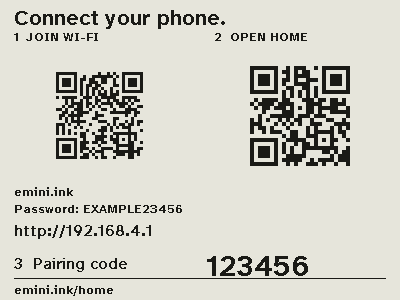
Renderer 0.4.0 · Setup screensample data -
Open the panel and pair
Go to
http://192.168.4.1and type the six-digit code from the display. The browser remembers the connection. The device keeps up to four browser connections, and pairing again on your home Wi-Fi uses a second one.
Panel 0.4.0 · Pairing -
Bring the device onto your Wi-Fi
Pick your network and enter its password; the device joins 2.4 GHz networks with WPA2 or WPA3 Personal. Then move your phone to the same Wi-Fi, open the address the panel shows and pair once more.

Panel 0.4.0 · Your home Wi-Fi -
See what is on the display
The Home tab shows the last picture the display confirmed, pixel for pixel, with its status and battery level.

Panel 0.4.0 · Home tab -
Adjust each screen
Every screen has its own page with a preview and a choice of composition, including In turn. On the Weather page, Search for your town and pick it from the list. The search goes from your phone to Open-Meteo, so the phone needs internet access, for example on your home Wi-Fi. Use my location lets the device estimate its area from its own internet address instead. Tap Save settings, then Show now to put the saved picture on the display.

Panel 0.4.0 · Weather page -
Give it a rhythm
Keep one screen, switch screens at three times of day you choose, or rotate anywhere from every few minutes to once a day. Quiet hours hold the picture still overnight.

Panel 0.4.0 · Rhythm tab
Your data
Who sees what.
No emini server sits between your phone, the device and the internet. The NOTE4C asks a few public services for what it shows, much like a browser would. Your phone talks to Open-Meteo only while you search for a town.
- MET Norway
- The forecast location, cut to 4 decimal places, and your internet address.
- Open-Meteo
- What you type into the town search, sent from your phone with the phone's internet address. The device saves only the place you pick.
- Your news feed
- A request for that feed and your internet address. BBC World unless you change it.
- FreeIPAPI
- Your internet address, when the panel asks the device to estimate its location.
- Time servers
- Ordinary time requests from your internet address, so the schedule and the date are right.
- Your network
- Your router and DNS server see the names the device looks up. Other devices on your Wi-Fi can see its name, address, firmware version and current screen without pairing.
- This website
- The device never contacts it. The site counts visits and link clicks with self-hosted Plausible, without cookies. Like any web server, its host and the analytics server see your IP address.
The panel runs over plain HTTP on your own network, and the device stores its settings, including your Wi-Fi password, without encryption. Keep it on a network you trust. Before you give it away, erase its settings over USB as the installation guide describes. That leaves the factory firmware's own settings area as it is, so a Wi-Fi password the factory firmware saved there stays in flash. Read the privacy notes.
Before you install
Tested on one NOTE4C.
Read these before you back up the flash.
Only the NOTE4C Devkit with the four-colour display. The preflight check cannot tell a NOTE4 from a NOTE4C, so check which one you have before you start.
Installed from scratch, verified and started on one NOTE4C Devkit with the factory partition layout.
Done end to end from an iPhone on that unit, from the setup Wi-Fi to the panel on your home network. Android phones have not been tried yet.
A full picture change takes about 25 seconds.
A town you search for, or an estimate from your internet address. The estimate can land on your provider's city, and it never replaces a town you picked.
Starting over, which erases only Home's settings over USB, has been done on that unit. If Home finds saved settings it cannot use, it starts with default settings or the setup screen instead of stopping.
Battery life has not been measured. Wi-Fi stays on and there is no deep sleep yet.
Restoring your factory backup uses the standard esptool procedure. It has not yet been tried on a real unit.
Over USB, following the installation guide again in a new, empty folder, so your first backup is never overwritten. The firmware does not check for new versions, so watch the releases on GitHub.
Install from your computer
You need a NOTE4C Devkit, a USB-C data cable, Python 3.10 or newer and esptool 5.4.0. Most of the time goes into backing up the flash. Start every install and update in a new, empty folder: esptool replaces a file with the same name without asking. Keep your first backup for as long as you own the device, and keep it private, since it can hold Wi-Fi passwords.
Buy a NOTE4C from ZECTRIX (affiliate link). 5% off via this link or with the code TOMASZ.
- Back up the whole flash, twice
esptool --chip esp32s3 -p PORT -b 460800 \ --after no-reset read-flash 0 ALL note4c-backup-a.bin esptool … read-flash 0 ALL note4c-backup-b.bin - Run the preflight check on both backups
python3 …/tools/preflight.py note4c-backup-a.bin \ note4c-backup-b.bin … - Write two files, then verify
esptool … write-flash … \ 0x8000 emini-home-0.4.0-partition-table.bin \ 0x20000 emini-home-0.4.0-note4c.bin - Start it and pick up your phone
esptool --chip esp32s3 -p PORT run
These commands are shortened. Copy the full ones from the installation guide.